For those of you who don’t know me, you almost certainly won’t know what I do. Of course, there are probably a load of people who do know me, who still don’t know what I do (and, no, “Nothing” is not the answer). I work as a software tester and I have done for the last 7+ years now in a few different places.
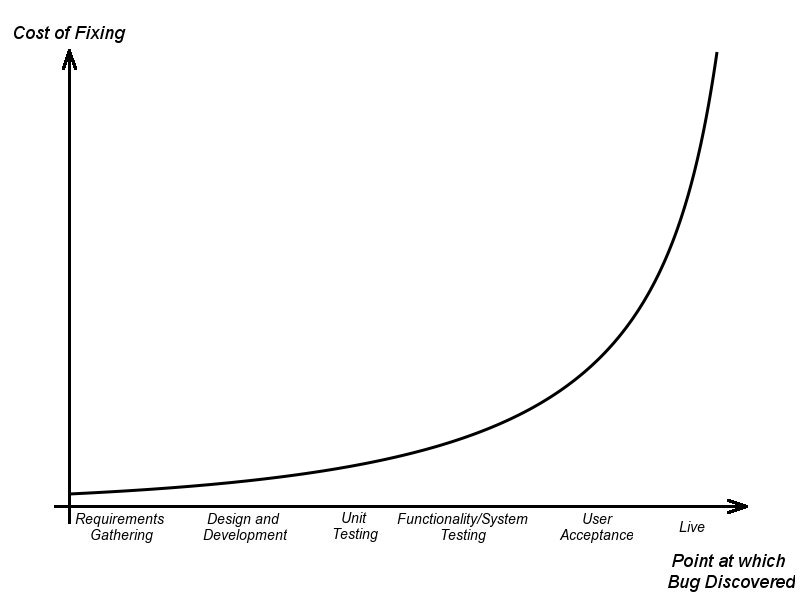 Generally, this job involves a fair bit of evangalism – sometimes it’s quite successful (eg Promoting the use of Bugzilla as a defect tracking tool). One of my favourite diagrams is that shown in this post – I like this graph a lot. It is a graph showing the rough relationship between the cost of fixing a bug or defect, and what stage of the development process that bug or defect was found.
It’s fairly clear from the graph that, the later you realise there is a problem, the more it costs you to go back and unravel what is wrong and sort it. The reasons are fairly clear – if you find a problem at a later stage, you often have to go right back to the beginning of the process of development, testing and so on.
Some notes I like to make relating to this:
- Even if you are already employed by a company, you are not “free”. Having someone fix a problem, and work repeated costs money – “we already pay their wages” is not an argument! Sheffield Teaching Hospitals Trust – take heed (Quote from the Reg article: The trust argued that the consequences of its decision making had not cost public money, “just time and effort by the IT teams”.).
- Accurate. timely requirements are essential. Finding out that you have mis-specified something as it is nearing the release date is a Bad Thing™.
- Not having requirements before coding is asking for even more trouble.
- Changing requirements part way through the process (or, worse, finding out during testing that your requirements were duff!) is much along the lines of 2 and 3 with similar outcomes (moving goalposts anyone?).
- Doing unit testing is much better than sending code straight to the testers – it saves a lot of heartache on both sides…
- Actually having enough time to perform a sufficient level of testing can save you an enormous amount of hassle and cost.
- Squishing bugs as you go at the earliest possible opportunity is much advised – multiple bugs can quickly make a system unusable and costly to fix up. (There is another similarly shaped graph – see it as The Law Of Bugterial Infection)
- No one is perfect… not even me 😉
Feel free to use the graph above if you want and evangelise away…